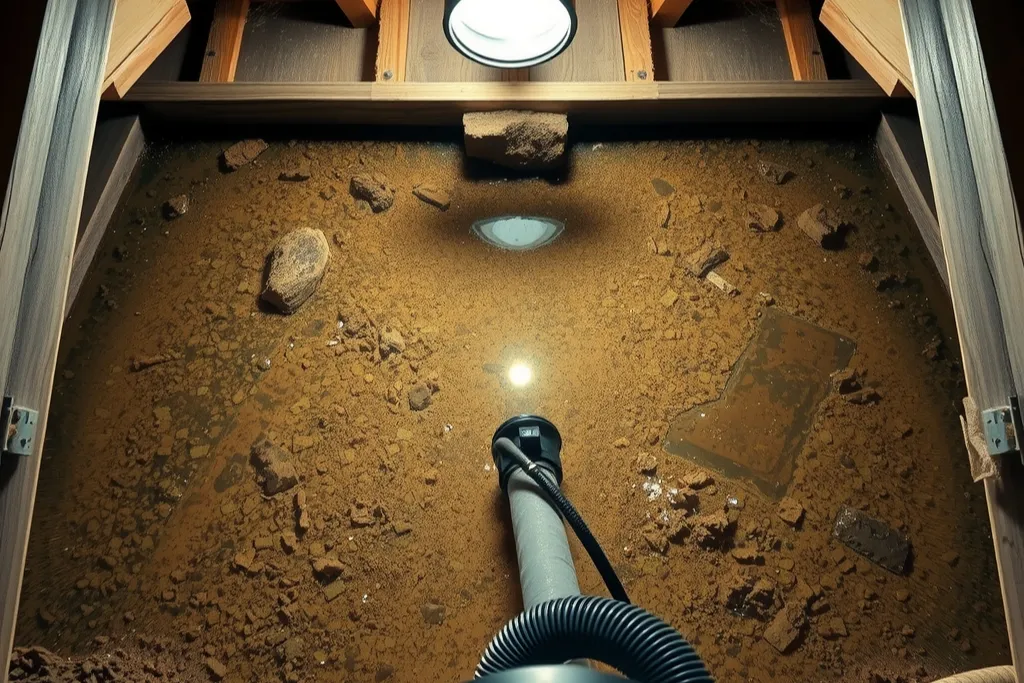
Does a wet crawl space really matter if nobody goes down there?
Yes, because the air and moisture in it are in contact with the floor you live on. Damp framing cups hardwood, softens subfloor and grows mold, and the smell travels up through registers and gaps. A crawl space is part of the house, not a separate outdoor space.
The underside of your floor is unfinished wood, and it takes up moisture from the air around it. When the space below stays damp through a wet season, the subfloor and joists rise in moisture content, hardwood above starts to move, and glued or nailed assemblies loosen. That is slow, quiet damage and it is almost always cheaper to stop than to replace.
There is also the air you breathe. Houses leak air upward, so a share of what is in the crawl space ends up indoors. That is why a musty hallway often turns out to be a crawl space problem rather than anything in the hallway itself.
Why is the insulation removed instead of dried?
Fiberglass batts hold water in the fibers and against the paper facing, they sag out of contact with the floor once wet, and they trap moisture against the joists. Drying them in place is slower and less reliable than taking them out, and they are inexpensive to replace after.
Wet batts behave like a sponge pressed to the underside of the floor. Even with fans running, the water held in them keeps feeding humidity into the space, and the facing stops the joists from drying at the same rate as bare wood. Crews take them out for the same reason carpet pad comes out upstairs.
Removal also lets someone look at what matters. With the batts down, the joists, the subfloor seams and the sill plate are visible and can be read with a meter and treated. Insulation goes back in at the end, once the wood is dry, which is also when the barrier is replaced.
What makes a crawl space wet in Puyallup specifically?
A long wet season does most of it. Roughly 35 to 40 inches of rain falls here each year, concentrated from November to March, and the valley floor has a high water table. Add vents at grade, downspouts near the foundation, and soil that cannot drain once saturated.
The pattern is seasonal rather than dramatic. Through the summer a crawl space here often dries out on its own and looks fine; by January the soil is saturated, the vents are admitting damp air, and anything that leaked in has nowhere to go. That is why an inspection in August can miss a problem that is obvious in February.
Position on the ground matters as much as the house. Homes on the valley floor near the river deal with the water table and with river water in flood years, which is handled on the Puyallup River flood damage page. Houses up on the South Hill plateau more often have a roof, gutter or plumbing source feeding the space.
What changes the scale of a crawl space or basement job?
How much water is in there, how long it has been, the square footage under the house, how much insulation and barrier has to come out, and how easy the hatch and the clearance make the work. No figure appears on this page; the scope and price are set out and approved before work begins.
Clearance is the factor owners never guess. A crawl space with eighteen inches of headroom, a hatch inside a closet, and ducts running across the middle takes far longer to work than an open one you can kneel in, for exactly the same amount of water. Stored belongings under the house add to that again.
Time is the other one. Water found the week it arrived is a pumping and drying job. Water that sat through a season has usually taken the insulation, started growth on the joists and raised the moisture in the subfloor, which widens the work considerably. Puyallup Water Damage Restoration measures the space, writes the scope against what is actually under the floor, and gets your approval first.
Will it flood again, and what can be done about that?
Cleanup dries the house; it does not change the ground. Gutters and downspouts carried away from the foundation, grading that falls away from the wall, a working sump and a sealed barrier all reduce the chance. A crew will tell you what it saw feeding the water.
Restoration and drainage are separate trades, and an honest crew will say so. What a drying crew can give you is the evidence: where the water entered, what was wet, how deep it was and which part of the perimeter it came from. That is the information a drainage or foundation contractor needs and it is far better than a guess made in dry weather.
Some fixes are cheap and worth doing before the next wet season. Extending a downspout, clearing a blocked vent, keeping stored material off the ground and replacing a torn barrier are small jobs. Washington contractors register with the Department of Labor and Industries, and you can check a registration on the agency's website before hiring anyone for that work.