What is actually still wet after the water is gone?
The parts you cannot see: the bottom plate of the wall, the insulation in that bay, the subfloor under the finish floor, the sheathing behind the drywall, and the ground or slab underneath. Those hold water long after a surface feels dry.
That is why this stage is measured rather than judged. A meter on the drywall face can read acceptably while the stud cavity behind it is saturated, and a crawl space under a dried kitchen can still be a shallow pond. A technician reads each material separately, because drywall, framing, subfloor and concrete all dry at their own rates and all have to get there.
Why do the windows have to stay shut in a wet Puyallup winter?
Because the air outside is often no drier than the air inside. Airflow alone only moves moisture from the material into the room; something has to take it out of that air, and in the wet season that something is a dehumidifier, not an open window.
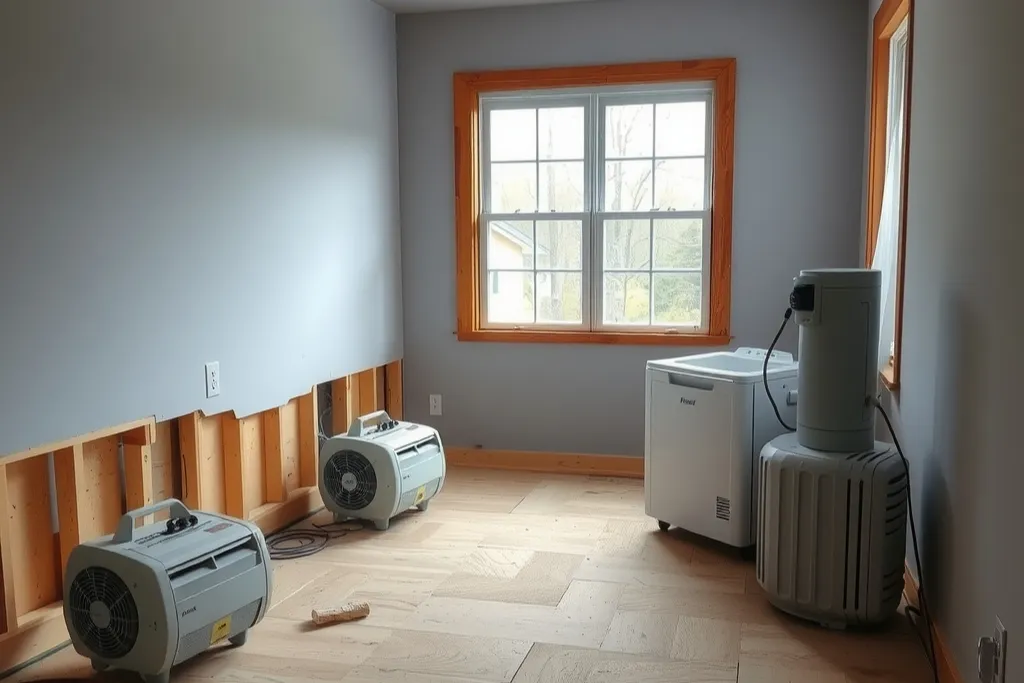
Water leaves a wet surface when the air touching it is drier than the material, so drying needs both moving air and a way to keep that air dry. A fan on its own raises the humidity of the whole house, which is how one wet room ends up with condensation in the next. Household dehumidifiers are a different class of machine from restoration units: they help a damp room and they will not pull framing down to target.
How many days will the equipment be in the house?
Most homes dry in a matter of days once the water is out and the unsalvageable material has gone, but no honest number exists before someone has measured. Material, how long the water sat, access and the season all move it.
The wet season lengthens it. With the ground saturated and the air near capacity from November through March, there is simply less drying potential available and the machines have to manufacture all of it, so the same loss in a Puyallup house finishes sooner in August than in January. The end point is still a reading: when every affected material matches its dry reference and holds there, the equipment comes out, whatever the calendar says. How long structural drying takes goes through what stretches it.
What makes a drying scope larger or smaller here?
How many rooms and assemblies got wet, how much material held water, whether cavities and a crawl space have to be dried, how many equipment days that takes, and the time of year. No figure is given unseen, and the scope is explained and approved before any machine is installed.
Equipment days are the main driver, because this is machines and visits over time rather than one task. A single wet room with a bare floor needs a modest system for a short run; a wet crawl space, three framed walls and a slab need more capacity and more days. Decisions about saving finishes change it too, since cavity drying that rescues an old floor takes longer than cutting it out, and that trade-off is put to you with the readings behind it.
What should I be left with when the drying is finished?
A log of readings for every affected material at every visit, a dry reference from the same material elsewhere in the building, dated photographs, and a clear statement of what was removed. Finished means the numbers match and hold, not that the machines were collected.
Keep that paperwork, because the repairs and any claim both lean on it. If you are choosing who does the rebuild afterwards, contractors in Washington register with the Department of Labor & Industries under chapter 18.27 RCW before they bid, advertise or work, registration requires a bond and insurance, and an unregistered contractor cannot sue to collect. You can check a contractor's registration on the Labor & Industries website before you sign anything.